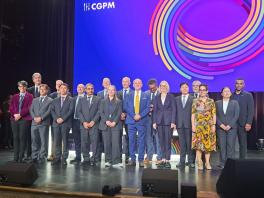
From Tuesday 13th to Thursday 15th October 2026, the Conférence générale des poids et mesures (CGPM) was held at the Palais des Congrès in Versailles. This diplomatic conference, which takes place approximately every four years, aims to propose and vote on resolutions for the development of metrology at the international level.
The French metrology attended the Conference
Image
On this occasion, French metrology was represented by Thomas Grenon, Director General of LNE; Maguelonne Chambon, Director of Research at LNE; Stéphane Plumeri, Deputy Director of Research at LNE; and Jean-Rémy Filtz, former Director of the Scientific and Industrial Metrology Department at LNE. The French delegation also included Sylvain Drouin, head of delegation; Elisabeth Dupin and Keireddine Hambli, from the DGE (Directorate General for Enterprises) / Ministry of Industry; and Noël Dimarcq, a member of CIPM. Also attending the Conference were Joseph Achkar from LNE-OP, representing the ITU (International Telecommunication Union); Gaël Obein from LNE-CNAM, representing the CIE (International Commission on Illumination); and Nicole Capitaine from the Bureau des Longitudes.
Approval of several resolutions
During the conference, several resolutions were adopted, including three concerning the domain of time and space:
1. On the roadmap for redefining the second
The objective is to adopt a new definition of the second based on optical frequency standards by the 29th CGPM in 2030. Work is continuing to validate the required criteria and choose the best option: a first based on a choice between several elements (such as strontium or ytterbium) and technologies (neutral atom clocks, trapped ion clocks), or a second based on a set of frequency standards.
2. On guaranteeing the continuity of Coordinated Universal Time – UTC
To avoid the introduction of a "negative leap second" (linked to unpredictable variations in the Earth's rotation), the maximum difference |UT1-UTC| will be increased to 3,600 seconds (1 hour) starting May 20, 2027. This measure will guarantee the continuity of UTC for several centuries, without major technical disruption to global infrastructure.
3. On the creation of a lunar reference time scale
Given the increasing number of space exploration missions and the deployment of positioning and navigation (PNT) systems on the Moon, it is necessary to define a specific reference time scale. Due to relativistic effects, UTC cannot be used directly on the Moon. This lunar time scale must, however, remain traceable to UTC and harmonized internationally.
Other decisions adopted
Following the spirit of the creation of the metre Convention in the early 18th century, and aiming for the widest possible dissemination of the decimal metric system, a resolution was adopted "on universal adherence to the metre Convention." This resolution provides states not participating in BIPM activities but committed to using the SI and UTC with the necessary means to establish links with the global measurement system by creating Observer status. These states will thus be able to monitor developments and resolutions concerning metrology at the international level.
Another important resolution adopted was "the continuation of the digital transformation of the global metrological system", to make the SI Reference Point a comprehensive and authoritative digital framework, to encourage harmonization to ensure consistency and interoperability of data and documents, and to facilitate progress in metrology with the use of artificial intelligence, for example.
Image
Furthermore, Jean-Rémy Filtz has been elected a member of the International Committee for Weights and Measures (CIPM), nominated by France, for the next four years. He succeeds Noël Dimarcq, who is currently the president of the CCTF (Consultative Committee on Time and Frequencies).